My Work · Open Source · AI · Software Engineering
I Built an Open-Source Dashboard for Spec Kit
Why I built SpecKit Governance Dashboard: a read-only, Markdown-first tool that turns scattered specs, tasks, decisions, and risks into one clear view of a project's progress.
What is Spec Kit, anyway?
GitHub Spec Kit is an open-source toolkit for spec-driven development.
Instead of jumping straight into “vibe coding,” you define what you are building, create an implementation plan, break it down into tasks, and let AI coding agents work against that structure.
In other words, the specification becomes the backbone of the development process—not another document you write once and forget about.
If you have ever managed a large project with Spec Kit, this will probably sound familiar:
At first, you have spec.md, plan.md, and tasks.md. Everything is clean, organized, and suspiciously under control.
A while later, you have dozens of features, checklists, contracts, decisions, evidence files, and review reports.
Everything you need is technically there.
Finding it is another story.
You may need to open fifteen files just to answer one simple question:
Where exactly do we stand?
That is where the idea for SpecKit Governance Dashboard came from.
Today, I am releasing it as an open-source project.
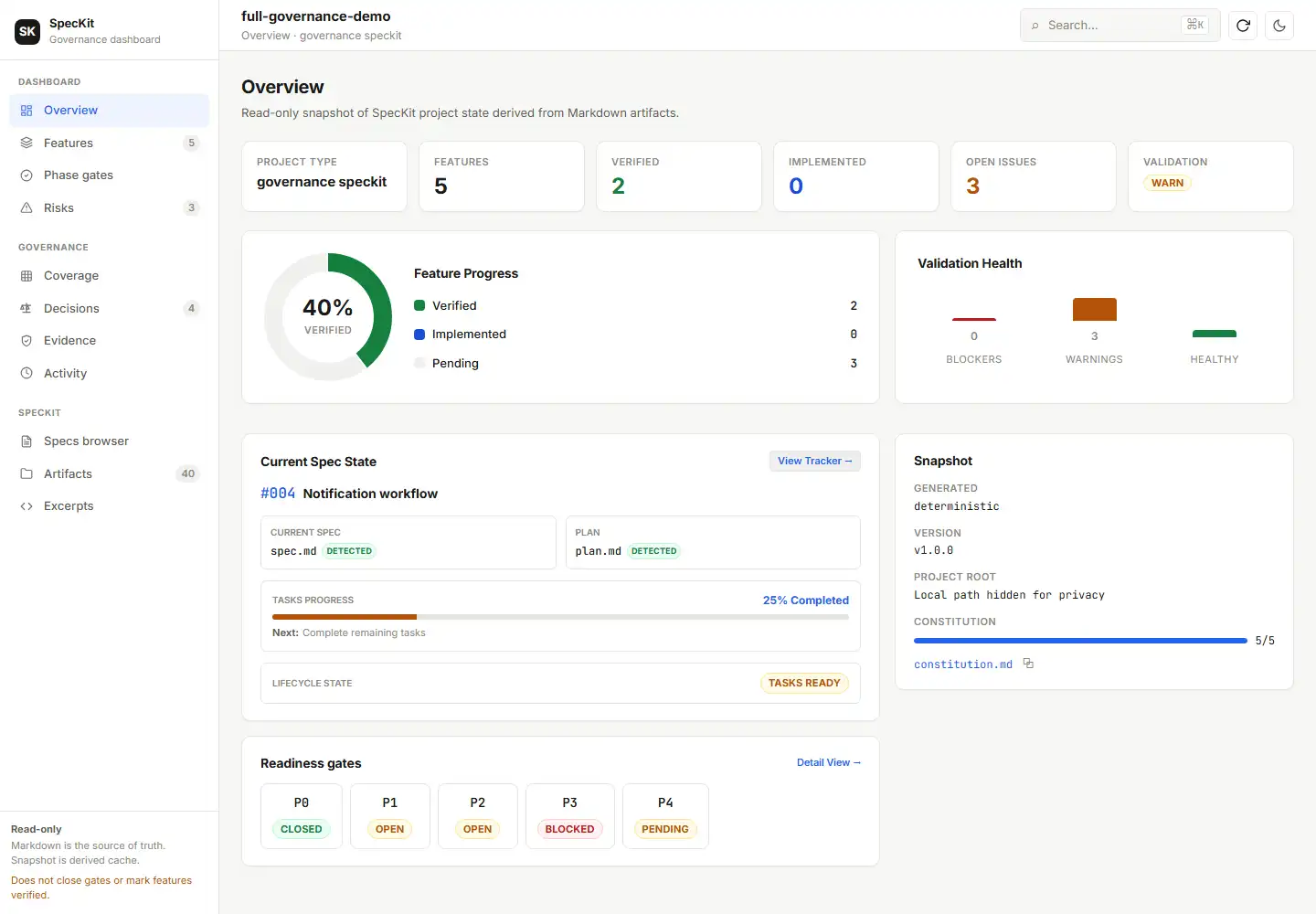
The dashboard scans the Spec Kit and Markdown artifacts in your project and turns them into a visual overview of its current state: features, implementation progress, phase gates, pending decisions, evidence, risks, and anything else that may need your attention.
The tool is completely read-only.
It does not modify your project files, and it does not try to replace Markdown with a database or another project-management system. Markdown remains the source of truth; the dashboard simply reads, organizes, and presents what is already there.
In other words, I did not solve documentation overload by introducing another system that needs its own documentation.
At least not yet. 😅
Why I built it
While working on a large project with Spec Kit, I noticed something slightly embarrassing:
The AI agent knew the project status better than I did. 😅
The documentation had grown so much that I was left with two options:
Burn tokens asking the agent to summarize the project, or burn my own time opening specs, reviewing completed work, checking dependencies, tracing decisions, and trying to understand where everything was heading.
The problem was not missing information.
The problem was visibility.
I wanted one place where I could follow progress, decisions, evidence, deliverables, and phase gates without building a separate management platform beside the files we already depended on.
The project is still in its early stages, and there is plenty of room for improvement. But it already handles the main job it was created for:
Turning scattered project artifacts into one clear view of what is done, what is blocked, what is missing, and what only looks green because nobody has inspected it closely enough yet.
You can explore the project and try it here:
SpecKit Governance Dashboard on GitHub
If you find a bug, forgive me first.
Then open an issue—or consider it your first contribution to the project. 😅